Year of our Lord 2026. LLMs are everywhere.
Built Lex, a context-aware dictionary.
|

|
Lex comprises three subsystems: lex-cgi, lex-llm, lex-mailer. User emails a word and an optional context (e.g., define quaint in ‘quaint river town’). lex-cgi receives webhook, runs lex-llm, writes definition to file. lex-mailer emails past entries daily, timed for spaced repetition.
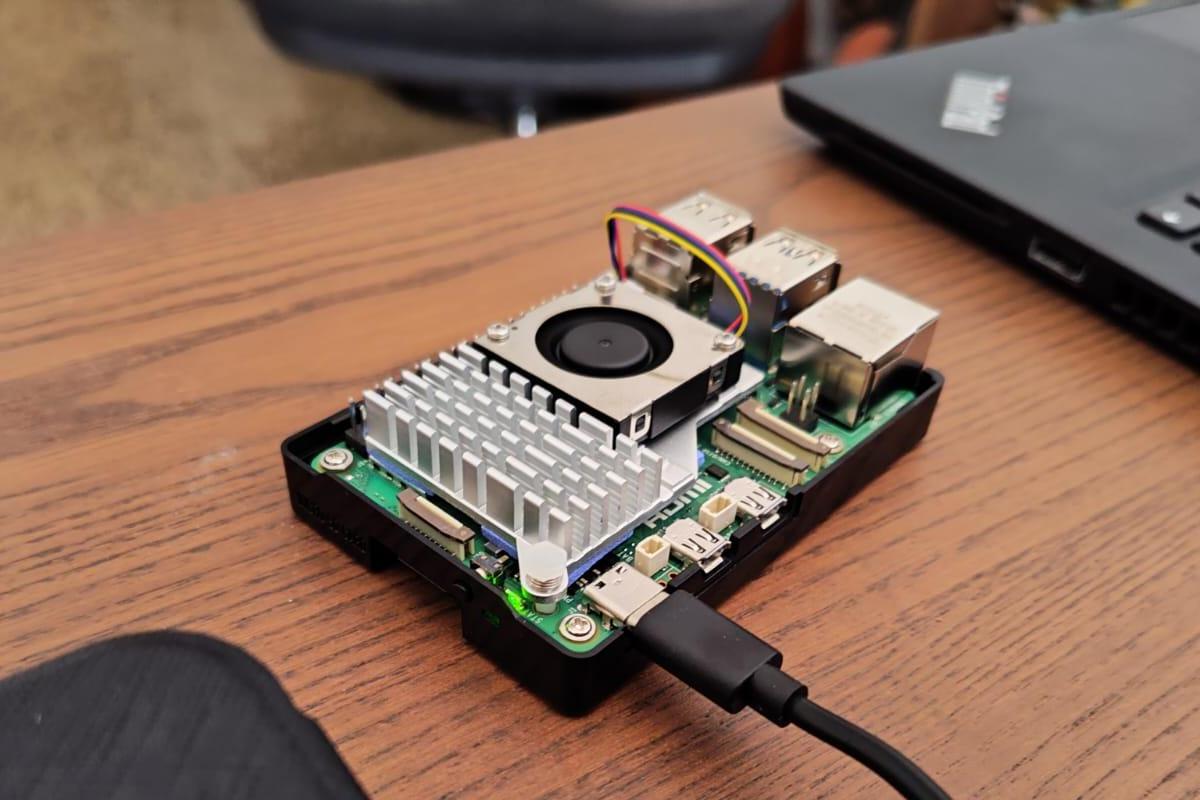
lex-cgi and lex-mailer could run on a $5/mo VPS. LLM inference, however, is memory intensive. A monolith hosting all three components would entail $850-$950 billion chatbots, data centers in space, and risking apocalypse—overkill for defining the occasional word. Even the less glamorous local inference options require a $20-$40/mo VPS. Decoupling them would let lex-llm run on hardware I own—a Raspberry Pi 5 I happened to have lying around.
lex-cgi: authenticates PGP signature, sanitizes input, and spools request to disk:
my ($pgp_sig) = $sig_part_raw =~ /(-----BEGIN PGP SIGNATURE-----[\s\S]*?-----END PGP SIGNATURE-----)/;
verify_pgp_signature($signed_part, $pgp_sig)

my $plain_text = $parts[0]->body_str // '';

open($sfh, '>:utf8', $tmp_spool_file);
print $sfh $plain_text . "\n";
close($sfh);

rename($tmp_spool_file, $spool_file);
A shell daemon periodically fetches them via SSH, runs lex-llm (listening on a Unix domain socket), and syncs output back to VPS:
prompt=$(ssh -F "${SSH_CONFIG}" -n "${SSH_HOST}" \
    "cat '${SPOOL_DIR}/${SPOOL_FILE}'")

response=$(print -r -- "${prompt}" \
    | nc -w 300 -U "${SOCK_PATH}" \
    | awk '# formatting fix, omitted'
)

# ${remote_cmd} validates output, writes to
# tmp_file, atomically mv into place, rm spool file
print -r -- "${response}" \
    | fold -s -w 72 \
    | ssh -F "${SSH_CONFIG}" "${SSH_HOST}" "${remote_cmd}"
)
lex-mailer: emails one definition daily, chosen for spaced repetition with fair scheduling:
my $pid = fork();
if ($pid == 0) {
    # child proc with its own pledge
    pledge(qw(stdio proc exec));

    my $raw_email;
    {
        local $/;
        $raw_email = <$child_sock>;
    }
    open(my $mail_pipe, '|-', $sendmail, '-i', '-f', $from, $to);
    binmode($mail_pipe, ':utf8');
    print $mail_pipe $raw_email;
    exit 0;
}

# Candidate selection (spaced repetition + fair scheduling)
my @due_files = grep { $state{$_}{next_due} le $today } @current_files;
my %weights;
my $total_weight = 0;
foreach my $file (@due_files) {
    my $w = 1.0 / ($state{$file}{reviews} + 1);
    $weights{$file} = $w;
    $total_weight += $w;
}

# Weighted random selection (roulette wheel algorithm)
my $rand_point = rand($total_weight);
my $accum = 0;
foreach my $file (@due_files) {
    $accum += $weights{$file};
    if ($rand_point <= $accum) {
        $selected_file = $file;
        last;
    }
}
lex-llm: runs llama.cpp + LLM inference to generate context- and tone-appropriate definitions:
for (i = 0; i < MAX_TOKENS; i++) {
    new_token_id = llama_sampler_sample(smpl, ctx, -1);
    llama_sampler_accept(smpl, new_token_id);

    if (llama_vocab_is_eog(vocab, new_token_id))
        break;

    char buf[128];
    n = llama_token_to_piece(vocab, new_token_id, buf, sizeof(buf), 0, false);
    if (n > 0) {
        fwrite(buf, 1, (size_t)n, out);
        fflush(out);
    }

    batch = llama_batch_get_one(&new_token_id, 1);
    if (llama_decode(ctx, batch) != 0)
        break;
}
Prompts that took 12 seconds on T490 takes 55 seconds on the RPi5’s slower Cortex-A76. Caching tokens from the previous prompt and decoding only the part that changes reduced that to 35 seconds:
/* drop everything after common prefix. */
llama_memory_seq_rm(llama_get_memory(llm->ctx), 0, n_common, -1);

/* decode the diff */
if (n_common < n_new_tokens) {
    batch = llama_batch_get_one(new_tokens + n_common,
        n_new_tokens - n_common);
    if (llama_decode(llm->ctx, batch) != 0)
        return;

    memcpy(llm->cached_tokens + n_common,
        new_tokens + n_common,
        (size_t)(n_new_tokens - n_common) * sizeof(llama_token));

    llm->n_cached_tokens = n_new_tokens;
}
Forcing the model to RAM at init via LLAMA_LOAD_MODE_MLOCK would have been desirable, but RPi5 lacks RAM to grant the mlock. LLAMA_LOAD_MODE_NONE yielded better steady-state performance than LLAMA_LOAD_MODE_MMAP (1.3 GB less MAX RSS, 1-2 seconds faster).
Deploying an LLM to a RPi5 with 4 GB RAM and 3.5 GB flash storage is its own adventure. Experimented with different models (Q4_K_M) and picked the smallest viable model first:
+--------------+--------+-------------+---------------------+----------+
| Model        | Tokens | Tok/s (μ±σ) |  Time s (Med/Range) | RAM (MB) |
+--------------+--------+-------------+---------------------+----------+
| Qwen 2.5 3B  |  114.0 | 5.22 ± 0.31 | 21.79 (19.39-25.20) | 3,235.22 |
| Qwen 2.5 7B  |  104.5 | 2.09 ± 0.07 | 49.27 (45.50-52.98) | 7,335.18 |
| Phi 3.5 3.8B |  128.2 | 2.06 ± 0.10 | 71.87 (48.67-72.37) | 3,922.55 |
| LLaMA 3.1 8B |  115.5 | 2.01 ± 0.08 | 57.10 (53.95-66.09) | 7,873.52 |
| Mistral 7B   |  106.6 | 1.67 ± 0.13 | 64.25 (57.85-66.86) | 7,535.61 |
+--------------+--------+-------------+---------------------+----------+
Larger models caught nuances smaller ones missed, but definitions weren’t consistently better. Gemma 2 9B generated empty responses due to chat template bug; fixed, but 7.8 GB RAM usage didn’t justify re-running benchmarks. Qwen 2.5 3B struggled with formality level, but produced tighter, faster definitions at 3.2 GB RAM and 2 GB storage.
Flashed OpenBSD onto the Toshiba micro SD card without man, game, and X file sets. Kept comp set to build lex-llm. lex-llm requires just over 2.2 GB to build. 2.2 GB left on the disk. Disabled boot-time library re-linking and purged /usr/share/relink to reclaim a further 450 MB.
Stripped llama.cpp to essentials during the build to yield a 12.9 MB executable:
cmake -S $(LLAMA_SRC_DIR) -B $(LLAMA_BUILD) \
    -DBUILD_SHARED_LIBS=OFF \
    -DGGML_OPENMP=OFF \
    -DGGML_VULKAN=OFF \
    -DLLAMA_BUILD_SERVER=OFF \
    -DLLAMA_BUILD_UI=OFF
    # + misc size-reduction flags, omitted

cmake --build $(LLAMA_BUILD) --config Release -j$$(sysctl -n hw.ncpu)
Backed up the executable and reinstalled OS removing also the comp set. OS + lex-llm + model now fits:
Filesystem     Size    Used   Avail Capacity  Mounted on
/dev/sd0a      3.5G    2.5G    815M    76%    /
mfs:76650     61.9M    5.0K   58.8M     1%    /tmp
mfs:29597     15.4M   87.0K   14.6M     1%    /var/run
mfs:35201     30.9M    113K   29.3M     1%    /var/log
Worked well for two weeks. Then the file system corrupted twice within a week. Disk had 400 MB+ free space; badblocks revealed no bad sectors. fsck_ffs reported a partially truncated inode indicating an interrupted write. Power-induced link glitch perhaps—no way to know now.
Hunted down anything that wrote to disk (cron, ntpd, sshd). Mounted /dev (sshd pty allocation) to mfs. Moved cron’s log to /var/log/cron and symlinked ntpd.drift to /var/run/ntpd.drift. Assigned a static IP and disabled almost all the daemons (dhcpleased, resolvd, slaacd). Placed a /root/.marker to catch anything I might have missed. / is now read-only:
/dev/sd0a on / type ffs (local, noatime, wxallowed, read-only)
mfs:69255 on /dev type mfs (asynchronous, local, nosuid, size=32768 512-blocks)
mfs:75124 on /tmp type mfs (asynchronous, local, nodev, nosuid, size=131072 512-blocks)
mfs:15499 on /var/log type mfs (asynchronous, local, nodev, nosuid, size=65536 512-blocks)
mfs:14160 on /var/run type mfs (asynchronous, local, nodev, nosuid, size=32768 512-blocks)
Deployment went smoothly, except the RPi5 wouldn’t boot without a serial adapter plugged into the JST port; RX pin floated with no internal pull-up enabled. Resolved by adding an external 10 kΩ pull-up (RX to 3.3 V).
Security: PGP authentication, lockfile semaphores, chroot, pledge + unveil guard the components. Bringing lex-llm into home network has inherent risks. In addition to the hardened OS, configured packet filter to block network scans, access to other hosts:
set skip on lo
block all

block out on $net_if to $home_net

# DNS lookups for ntpd
pass out on $net_if proto { tcp, udp } to $router port domain

# outbound ssh to VPS
pass out on $net_if inet proto tcp from ($net_if) to $vps port ssh

# ntpd constraints check
pass out on $net_if proto udp to ! $home_net port ntp
pass out on $net_if proto tcp to ! $home_net port https

# inbound SSH from local network management hosts
pass in on $net_if inet proto tcp from $home_net to ($net_if) port ssh
End of line.
Source: b904341